There are no items in your cart
Add More
Add More
| Item Details | Price | ||
|---|---|---|---|

"A demerger changes the organisational context. A turnaround changes the competitive outcome."
Why would a company separate a business that was still profitable and operating in a growing market?
This question makes the Kwality Wall’s story strategically important. The business had recognised brands, respectable margins and meaningful long-term potential. Yet its position in India remained weaker than one might expect from a category supported for decades by Hindustan Unilever.
The obvious explanation is that the business failed to compete effectively. However, the case raises a more demanding possibility: the business may also have been constrained by the organisational system in which it operated.
Large companies are usually designed around a dominant operating model. Their supply chains, investment processes, managerial routines and performance measures support the categories that form the core of the organisation.
This creates efficiency, but it can create difficulties for businesses with very different requirements.
Ice cream depends on specialised infrastructure, seasonal planning, freezer availability and a distinctive route to market. These needs do not fully resemble those of conventional ambient FMCG categories. A business can therefore possess market potential while remaining disadvantaged by systems that were designed for other products.
This is the idea of organisational misplacement. It does not imply that the parent company managed the business carelessly. It suggests that the organisation may have been optimised for a different set of activities.
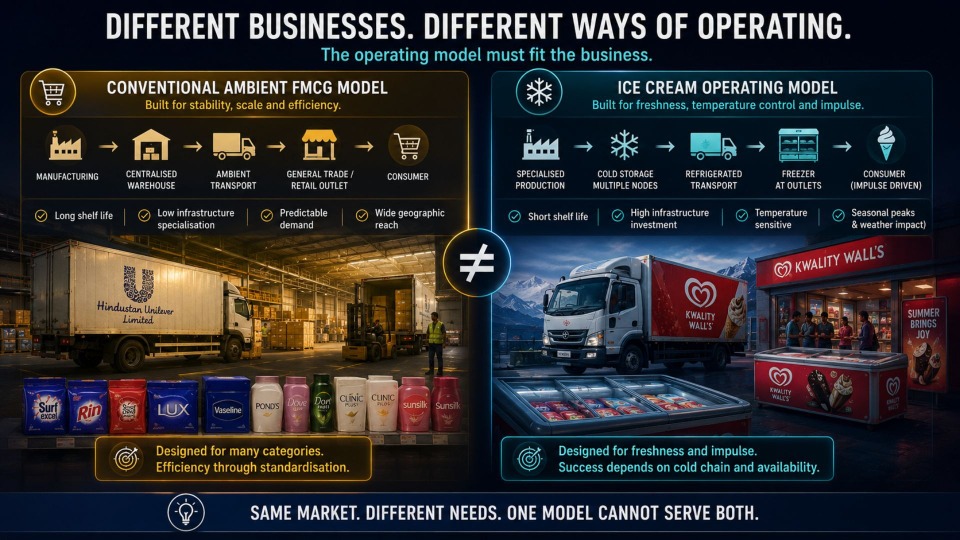
The separation of Kwality Wall’s can therefore be viewed as an attempt to create a more suitable organisational home, with dedicated management attention and an operating model aligned to the category.
A standalone organisation can make decisions according to its own priorities. It can build specialised systems, allocate capital more directly and focus management attention on one category.
However, independence does not automatically create market leadership.
A business may still face competitors with stronger distribution, lower costs, deeper local capabilities or structural advantages that cannot be reproduced quickly. Organisational separation may remove internal constraints, but it does not instantly create competitive strength.
This is why a demerger should not be treated as the turnaround itself. It creates the conditions under which a turnaround might become possible.
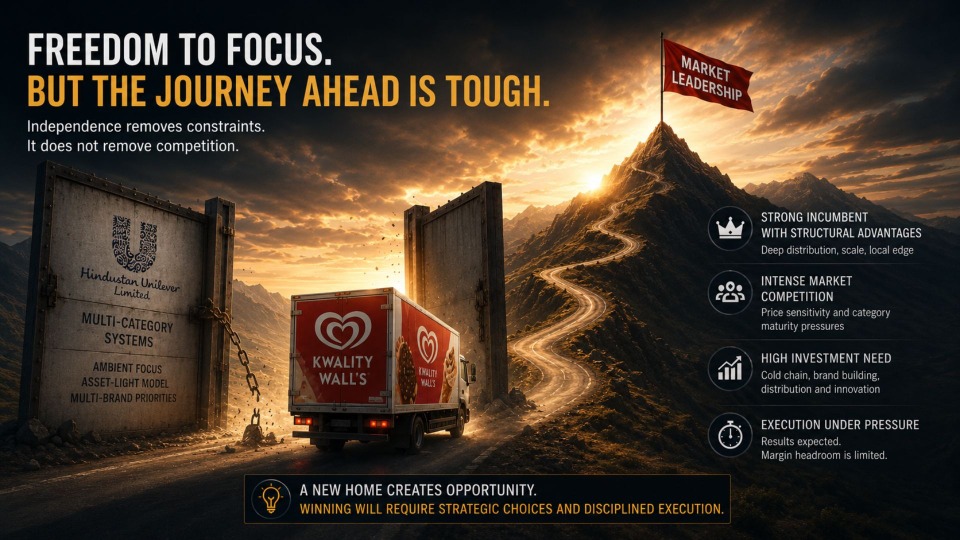
The outcome depends on whether the business can use its new freedom to build capabilities that were previously underdeveloped or constrained.
The most important question is therefore not whether the separation was correct. The more valuable question is whether management diagnosed the source of the underperformance correctly.
If organisational misfit was the main problem, independence could unlock growth by allowing the business to operate according to the realities of the ice cream market.
If the greater problem was competitive weakness, a new organisational structure would not be enough. The company would still need to find a defensible position against competitors whose advantages had been built over many years.
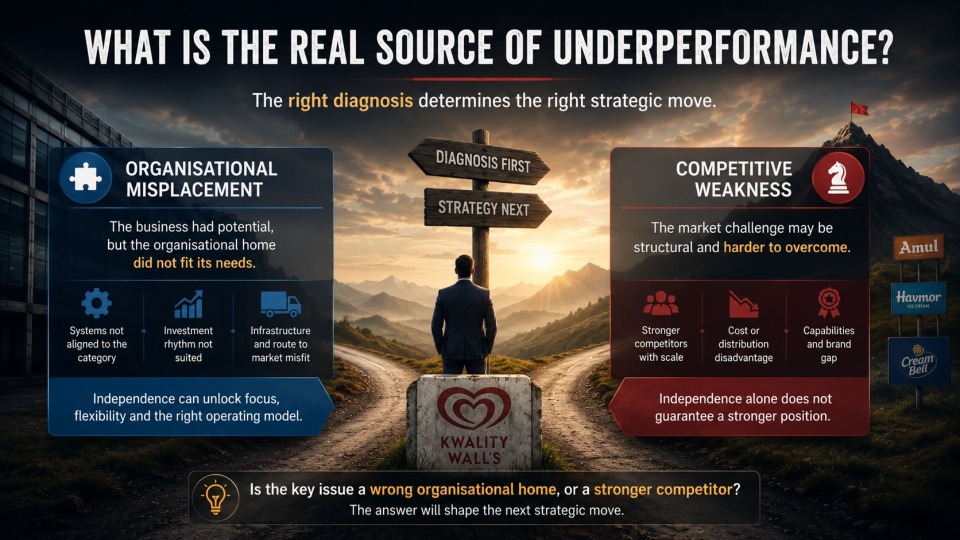
In practice, both explanations may be valid. A business can be constrained by its organisational home while also confronting stronger rivals.
This makes the case especially useful for strategic analysis. It prevents learners from reducing a complex situation to a single framework or a simple success-versus-failure conclusion.
Kwality Wall’s: New Home, Same Market is designed for courses in Strategic Management and Marketing Management.
The complete case provides the evidence, exhibits and decision context needed to examine organisational fit, portfolio restructuring and competitive turnaround. The accompanying teaching note supports faculty with structured discussion guidance and theoretical linkages.
Purchase the complete case study and teaching note from Conlear Education and use this live strategic dilemma to develop stronger managerial judgement.

Vinayak Buche
Vinayak is the Founder of Conlear Education.
 Launch your Graphy