There are no items in your cart
Add More
Add More
| Item Details | Price | ||
|---|---|---|---|

When two firms face the same cost change but respond differently, the difference usually comes from their assumptions about future growth.
Mon Feb 23, 2026
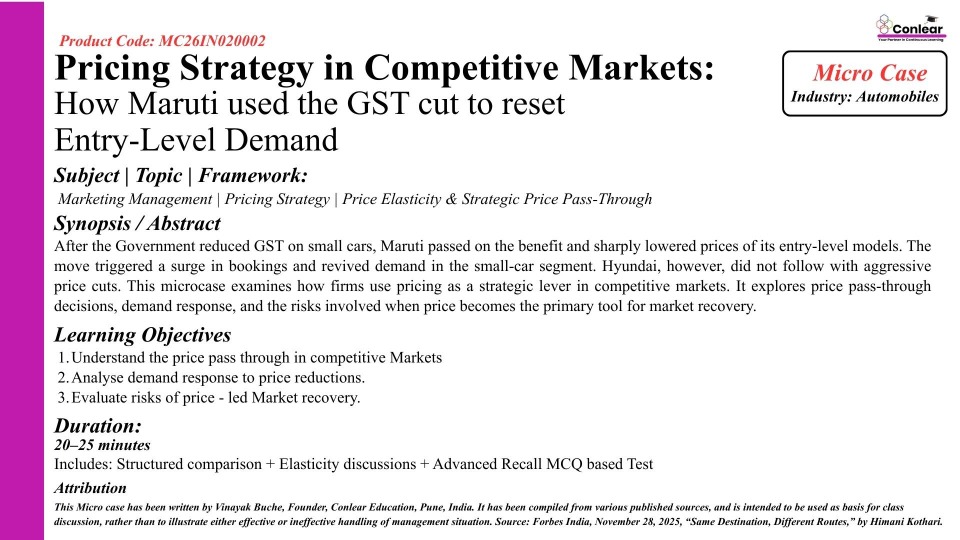
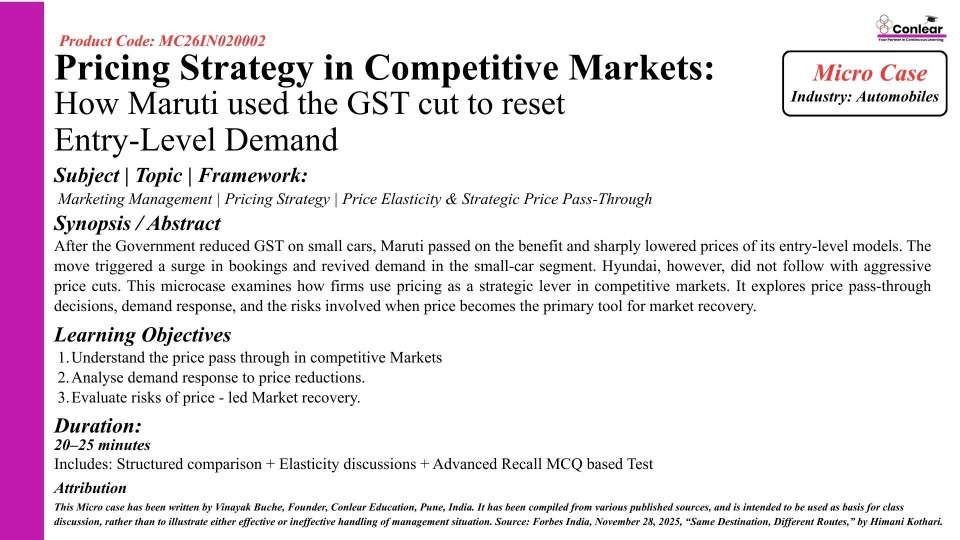
In competitive markets, pricing decisions are often treated as routine reactions to cost changes. When costs fall or taxes are reduced, many people assume prices will automatically come down. In reality, pricing decisions are rarely automatic because they reflect how managers see the market and where they believe growth will come from.
A reduction in indirect taxes such as GST creates a cost advantage, but firms can use that advantage in different ways. Some firms reduce prices in order to stimulate demand and attract more customers, while others keep prices unchanged and use the benefit to strengthen margins. Both choices can make sense, but they reflect different beliefs about the market.
Pricing decisions therefore tell us how a firm thinks about the demand and competition. When two firms face the same cost change but respond differently, the difference usually comes from their assumptions about future growth. Managers should therefore see cost reductions not just as financial adjustments but as opportunities to influence how the market develops.
A tax cut reduces costs, but its impact goes beyond the cost structure because it also changes how customers think about prices. Once customers see lower prices, those prices quickly become the new normal, and raising prices later becomes difficult.
Passing on a tax reduction can increase demand, especially in price-sensitive segments where even a small reduction can influence buying decisions. In categories such as entry-level cars or consumer durables, a price reduction may encourage customers who were undecided to enter the market. Lower prices therefore do not just shift market share; they can expand the size of the market itself.
However, the same decision can create long-term constraints. Once customers get used to lower prices, future increases become harder to justify. Firms that retain the tax benefit avoid this problem and maintain pricing stability, but they may also grow more slowly if competitors use lower prices to attract customers. The real issue is not whether to pass on the benefit, but how the decision fits the firm’s long-term direction.
Different pricing responses to the same tax cut usually reflect different views about demand. A firm that reduces prices significantly is making a bet that demand will increase enough to compensate for lower margins.
This approach is common among firms that see strong growth potential in price-sensitive segments. Lower prices can attract new customers and increase volumes, which may strengthen the firm’s cost position and market presence over time. In such cases, price reductions are meant not only to win customers from competitors but also to bring new customers into the market.
A firm that maintains prices is making a different judgement. The belief is that demand is stable and that customers value the product enough to accept unchanged prices. In this situation, protecting margins may be seen as more important than uncertain volume growth. Pricing decisions therefore reflect a firm’s underlying belief about how demand will behave.
Pricing decisions do not happen in isolation because competitors always respond. The final outcome depends not only on one firm’s decision but also on how other firms react.
If several firms reduce prices at the same time, market prices fall and margins come under pressure across the industry. Customers benefit, but industry profitability may decline. If only one firm reduces prices, it may gain market share and force competitors to decide whether to match the reduction or maintain their prices and risk losing customers.
Pricing can therefore become a competitive weapon. Firms with stronger cost structures may be better able to handle lower margins and may use price reductions to strengthen their position. However, aggressive price cuts can backfire if demand does not increase as expected. Lower margins are easy to implement but difficult to reverse, which makes pricing decisions particularly important.
The main trade-off in tax-driven pricing decisions is between protecting margins and expanding the market. Passing on tax benefits through lower prices can increase demand, improve market penetration, and strengthen a value-for-money image.
Retaining tax benefits protects profitability and preserves pricing flexibility. This approach allows firms to invest in product improvements and brand building, but it may also mean slower growth if competitors use lower prices to attract customers. A good pricing strategy balances growth and margin stability rather than focusing only on one objective.
When costs fall, managers often focus on the immediate financial impact of price changes. The more important question is how pricing decisions influence the future structure of the market.
A tax reduction creates a short window of opportunity where firms can reposition themselves. Pricing decisions taken at such times can influence market share, customer expectations, and competitive behaviour for many years.
Managers should therefore ask a simple question before changing prices: what does this decision say about how we see the market?
A tax cut is not just a financial event. It is a moment that reveals how a firm chooses to compete.

Vinayak Buche
Vinayak is the Founder of Conlear Education.
 Launch your Graphy