There are no items in your cart
Add More
Add More
| Item Details | Price | ||
|---|---|---|---|

Many firms reach a stage where growth in their core business begins to slow down. At that point, diversification looks like a natural next step. New product categories appear attractive because they promise additional revenue streams and reduced dependence on a single business. However, history shows that diversification by itself does not guarantee success. Many companies enter new markets only to discover that growth requires more than ambition and investment.
What separates successful diversification from failed expansion is often the presence of transferable capabilities. Companies that expand effectively usually build on what they already know how to do well. Instead of starting from scratch, they extend existing strengths into adjacent markets where those strengths remain relevant.
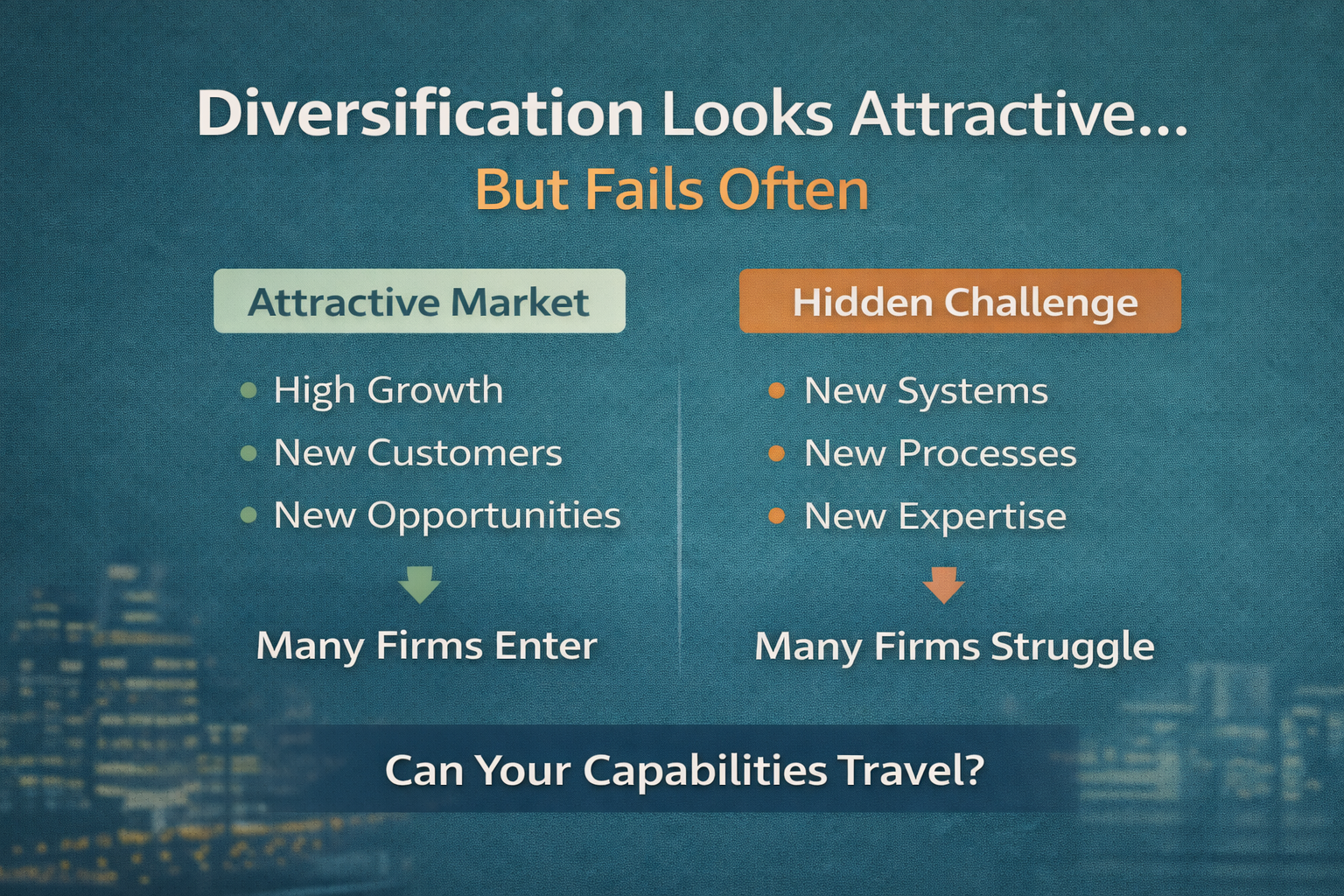
This is where the idea of capability-led diversification becomes important. Growth becomes more manageable when the firm relies on established systems rather than unfamiliar ones. The question is not simply whether a new market is attractive, but whether the firm is naturally equipped to compete in it.
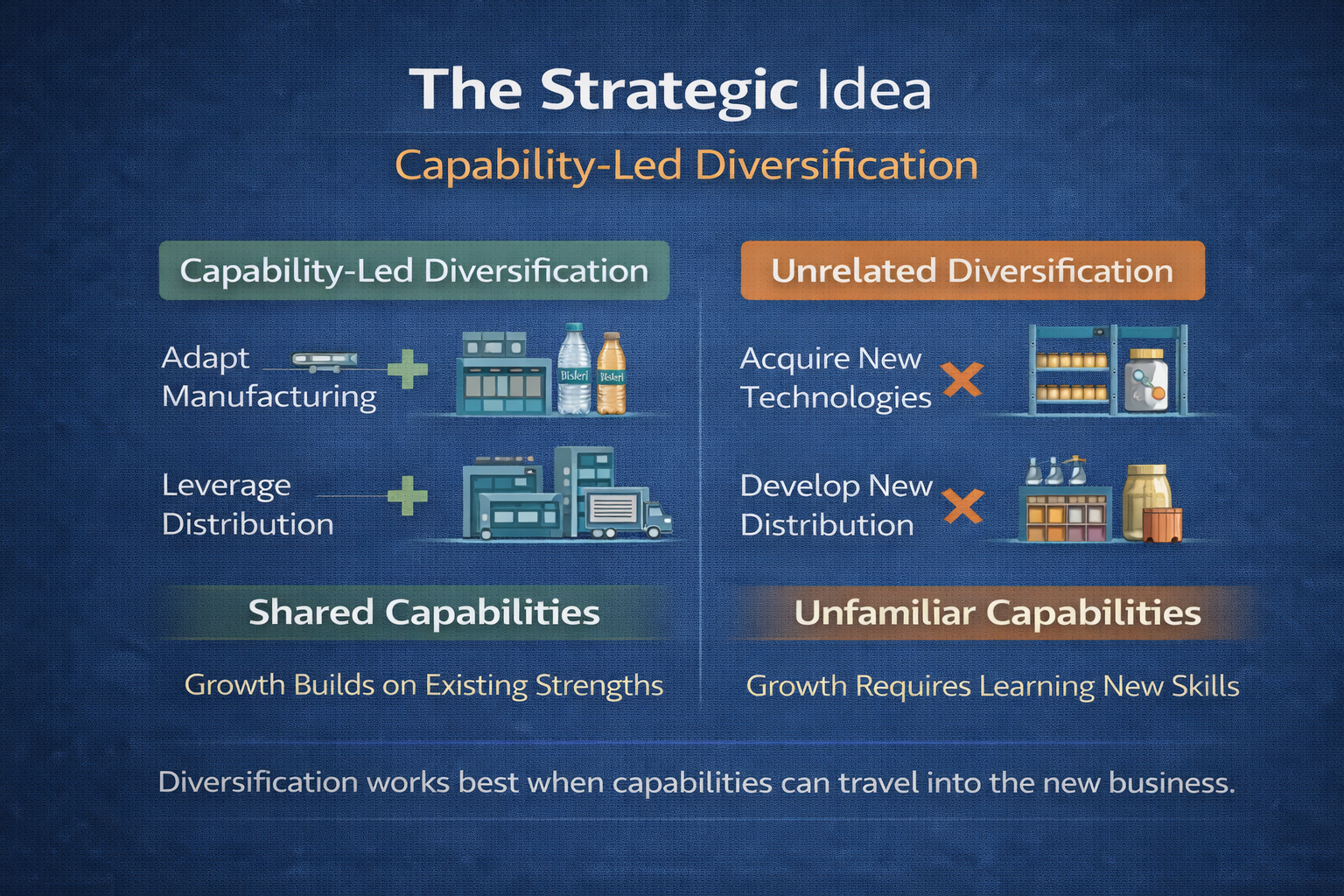
Capability-led diversification is based on the idea that firms possess unique strengths that can be redeployed across product categories. These strengths may include manufacturing expertise, supply chain systems, product development knowledge, distribution networks, or brand credibility. When diversification builds on these foundations, companies can expand with lower uncertainty and lower execution risk.
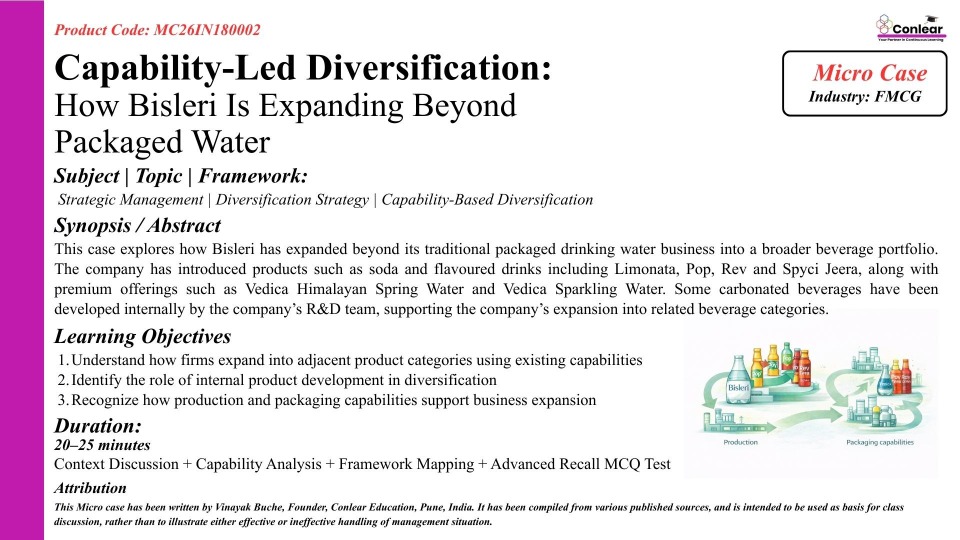
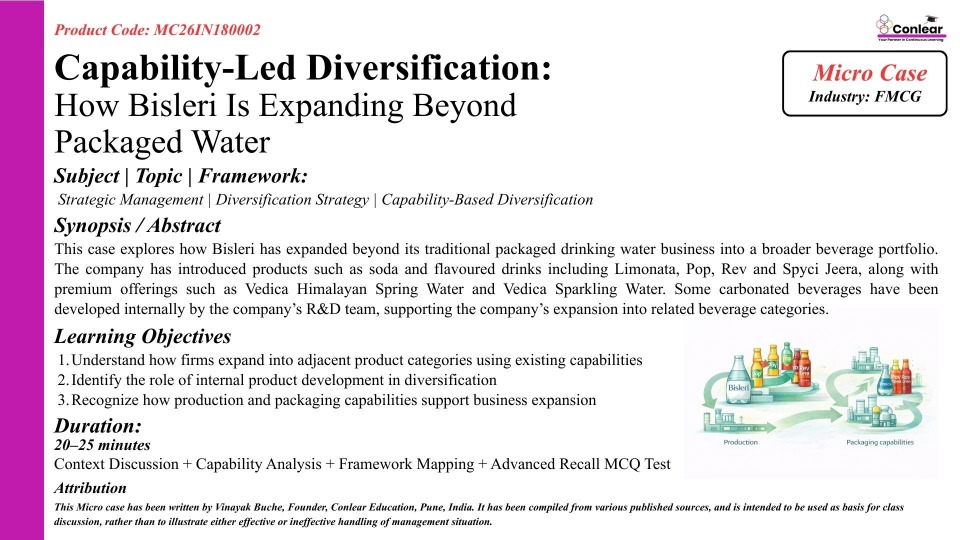
The experience of Bisleri illustrates this approach. As a leading packaged drinking water brand, the company developed strong production infrastructure, packaging capabilities, quality-control systems, and nationwide distribution reach. These assets were built over decades to support the bottled water business.
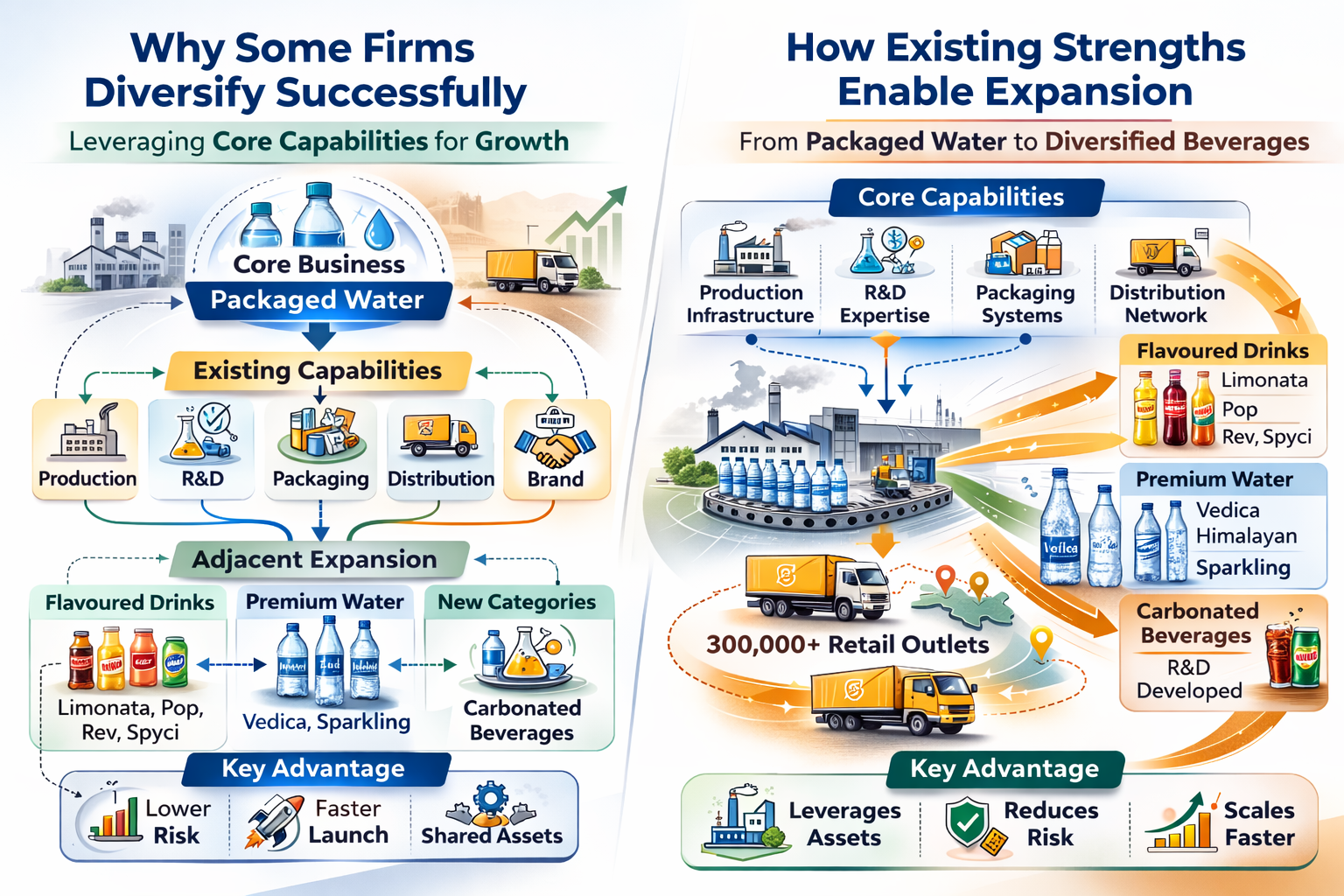
When Bisleri explored opportunities beyond packaged drinking water, the logic was not to enter completely unrelated industries. Instead, the company considered product categories that could use the same manufacturing systems, packaging technologies, and distribution channels. In such cases, expansion does not require building an entirely new organization. The same factories, logistics networks, and retail relationships can support multiple product lines.
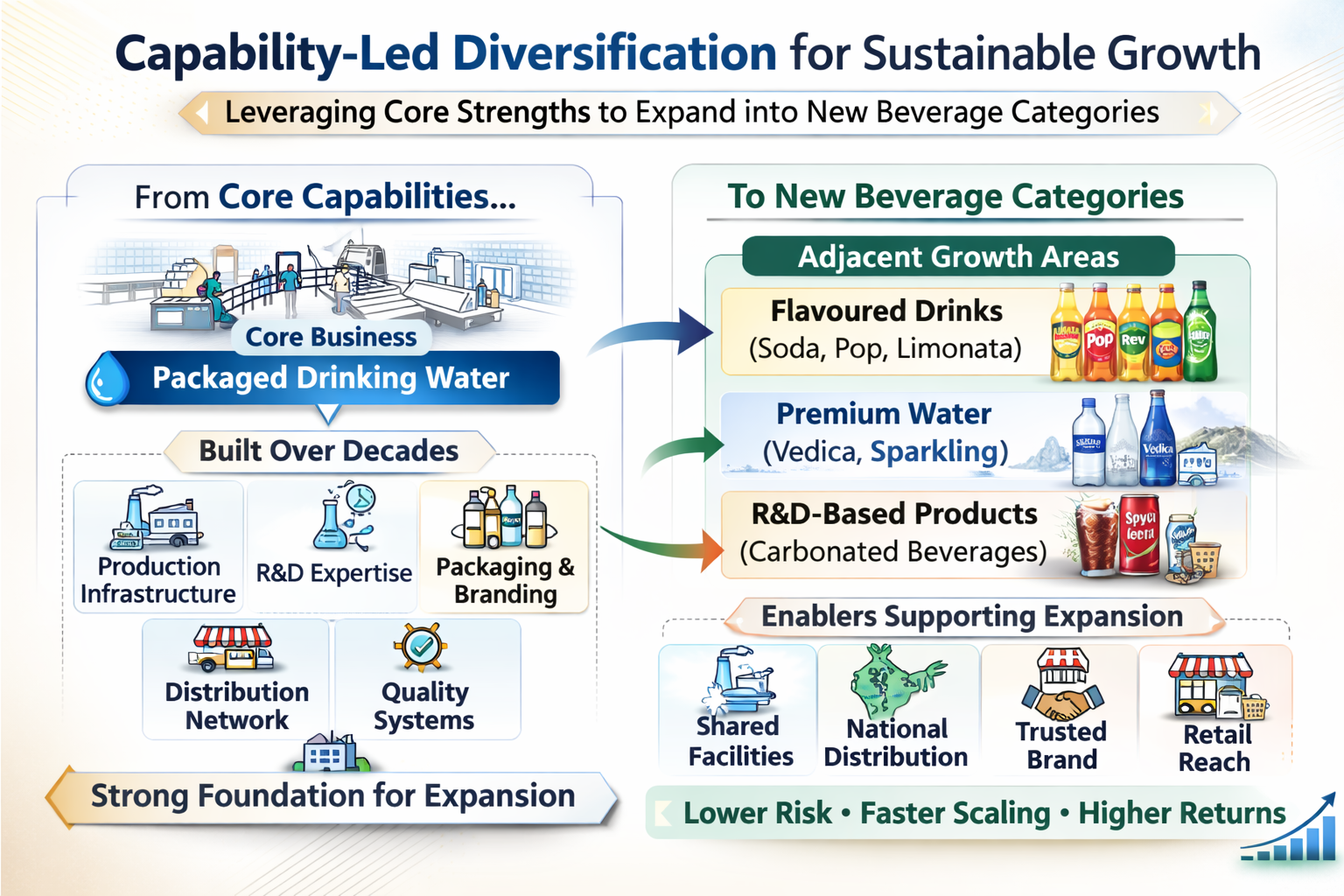
This approach reduces both operational complexity and financial risk. Investments tend to be incremental rather than transformational, and managers can rely on familiar processes instead of learning entirely new business models.
Capability-led diversification works because it leverages accumulated experience. Over time, firms develop routines and systems that improve efficiency and consistency. When expansion builds on these routines, the organization does not need to reinvent itself.
Manufacturing facilities may be adapted rather than replaced. Distribution networks may carry additional products without significant redesign. Supplier relationships may support new product lines with minimal adjustment. Even sales teams may find it easier to introduce new products when they are already trusted by retailers.
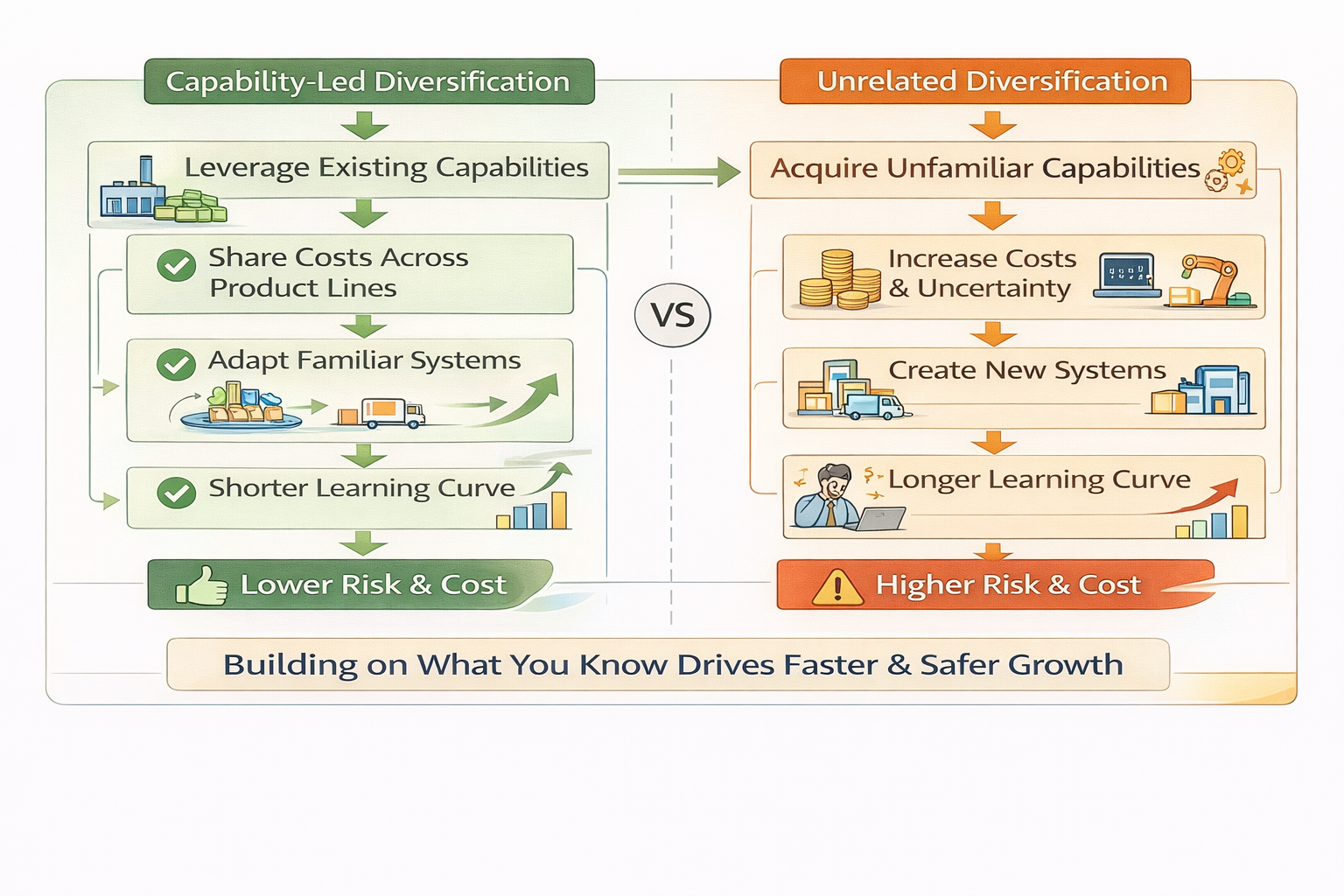
These advantages create a form of hidden economy. Costs are shared across product lines, learning curves are shorter, and mistakes are less likely to be expensive. Managers often underestimate how valuable these existing systems are until they attempt expansion into areas where such systems are absent.
In contrast, unrelated diversification forces firms to acquire unfamiliar capabilities. New production technologies, new customer segments, and new distribution models require learning that can be slow and costly. The firm may appear diversified on paper, but internally it may be operating several disconnected businesses without shared strengths.
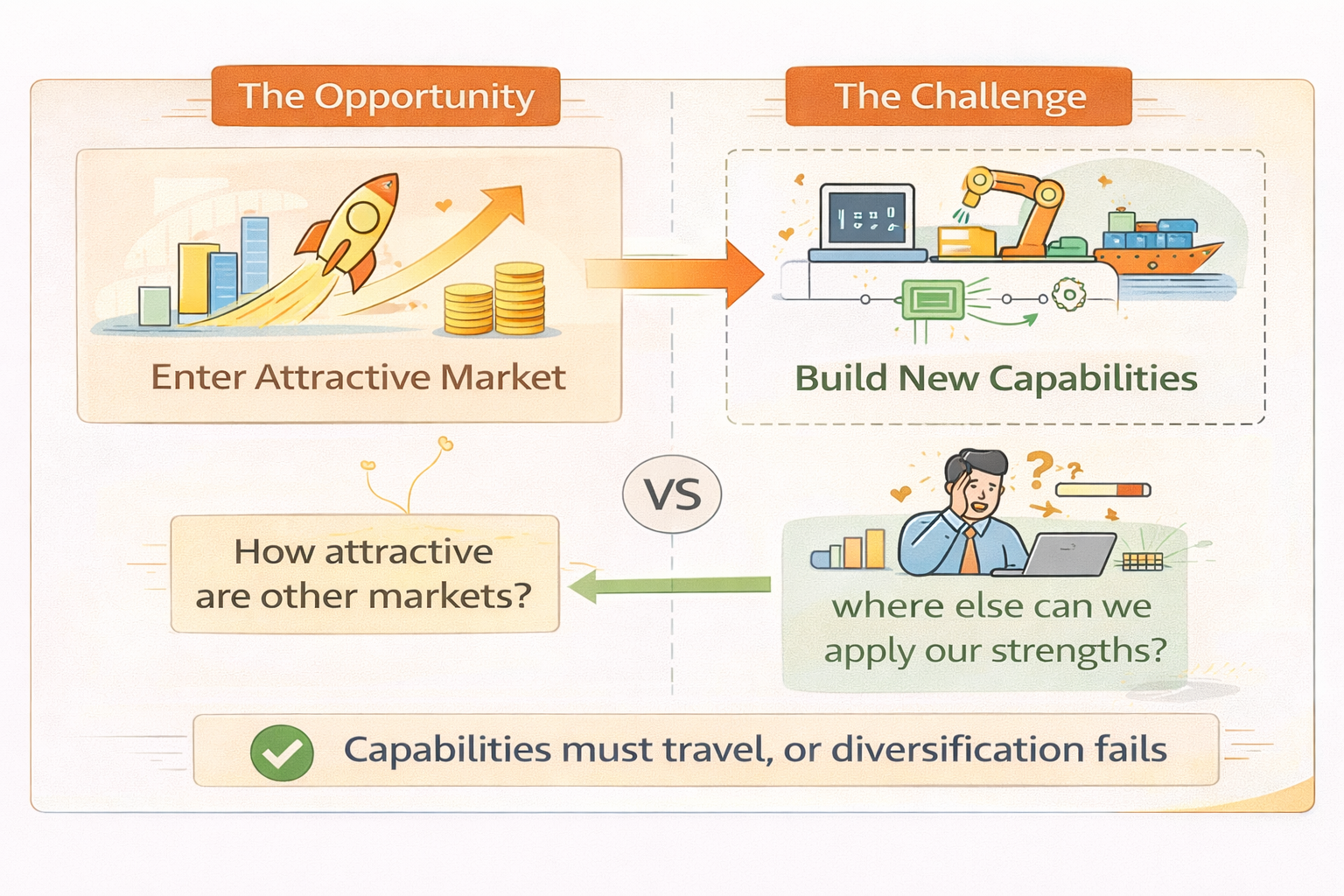
Capability-led diversification requires managerial discipline because not every growth opportunity fits the firm's strengths. Attractive markets can tempt companies into expansion even when they lack the required capabilities. Growth opportunities that look promising from a market perspective may be difficult to execute from an operational perspective.
Managers therefore need to ask a simple but demanding question before diversifying: What capabilities make us successful today, and can those capabilities be used in the new business?
This evaluation forces managers to think in concrete terms. Instead of focusing only on market size and growth rates, they must examine production systems, distribution reach, technological know-how, and organizational skills. Diversification becomes a strategic extension rather than a speculative bet.
Capability-led diversification does not eliminate risk, but it reduces avoidable uncertainty. Firms still need to understand customers and competitors in the new market, but they do not need to rebuild the entire organization to compete.
Diversification is most sustainable when it strengthens the firm rather than stretching it beyond its limits. Capability-led expansion allows companies to grow while reinforcing the systems that made them successful in the first place.
Firms that follow this path tend to expand steadily rather than dramatically. Their growth may appear less exciting in the short term, but it is often more durable over time. Each new product builds on the previous one, creating a portfolio connected by shared capabilities.
Managers often discuss diversification in terms of industries and markets, but the deeper question is about capabilities. Companies do not succeed because they enter attractive industries. They succeed because they bring distinctive strengths into those industries.
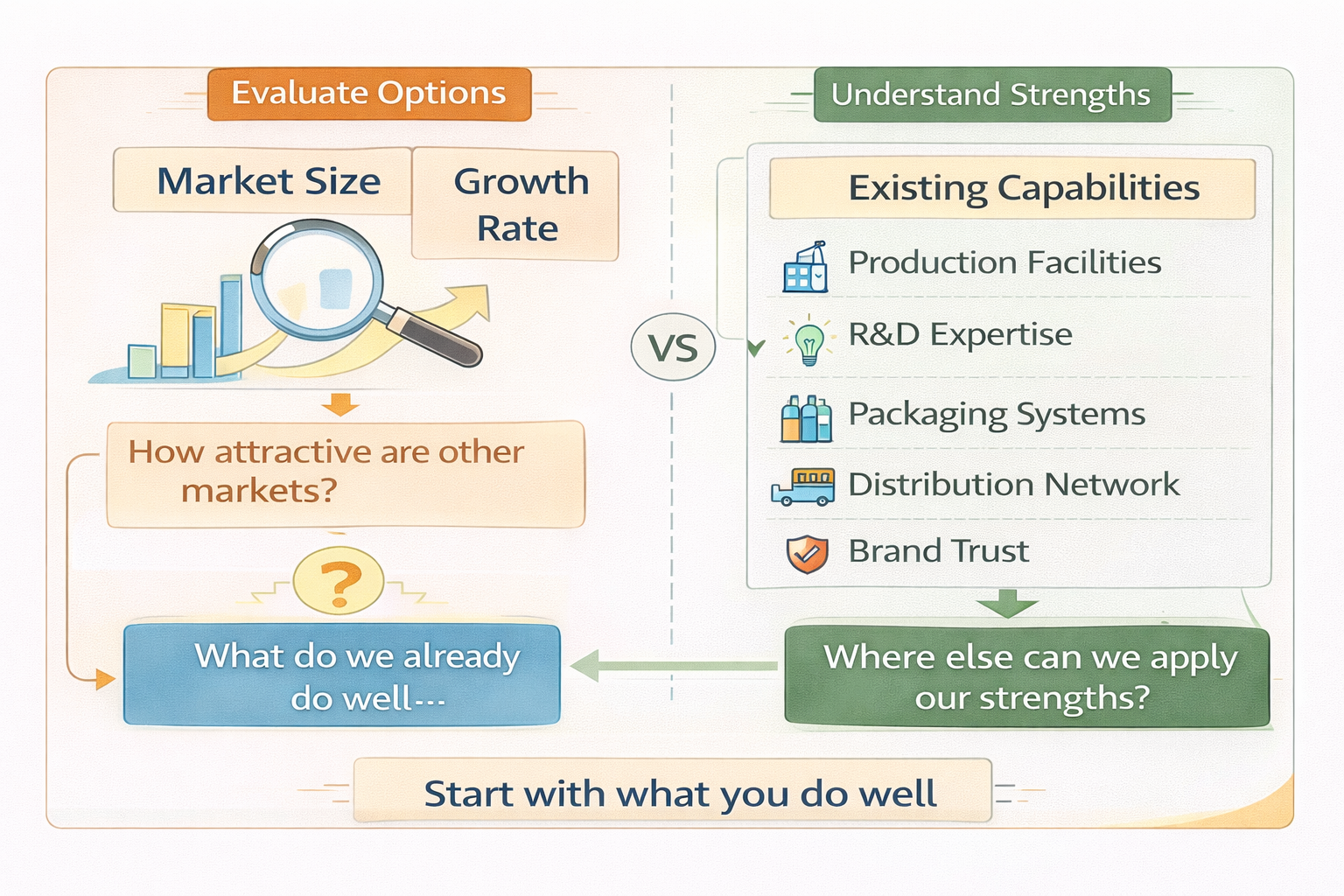
Capability-led diversification therefore shifts the focus from where to grow toward how to grow. The most reliable expansion opportunities are often those that allow firms to use what they already do well in new ways.

Vinayak Buche
Vinayak is the Founder of Conlear Education.
 Launch your Graphy